This is default featured slide 1 title

Go to Blogger edit html and find these sentences.Now replace these sentences with your own descriptions.This theme is Bloggerized by Lasantha Bandara - Premiumbloggertemplates.com.

This is default featured slide 2 title

Go to Blogger edit html and find these sentences.Now replace these sentences with your own descriptions.This theme is Bloggerized by Lasantha Bandara - Premiumbloggertemplates.com.

This is default featured slide 3 title

Go to Blogger edit html and find these sentences.Now replace these sentences with your own descriptions.This theme is Bloggerized by Lasantha Bandara - Premiumbloggertemplates.com.

This is default featured slide 4 title

Go to Blogger edit html and find these sentences.Now replace these sentences with your own descriptions.This theme is Bloggerized by Lasantha Bandara - Premiumbloggertemplates.com.

This is default featured slide 5 title

Go to Blogger edit html and find these sentences.Now replace these sentences with your own descriptions.This theme is Bloggerized by Lasantha Bandara - Premiumbloggertemplates.com.

Kamis, 10 Mei 2018

Free PDF , by Charles C. Mann

Free PDF , by Charles C. Mann

It is not only to provide you the very easy means yet likewise to get guide is soft data systems. This is the reason that you can get the book immediately. By linking to internet, your opportunity to find and get the , By Charles C. Mann as soon as possible. By clicking link that is proffered in this website, you could go to straight the book site. And, that's your time to get your favourite publication.

, by Charles C. Mann

, by Charles C. Mann


, by Charles C. Mann


Free PDF , by Charles C. Mann

Just what do you do to begin checking out , By Charles C. Mann Searching the publication that you like to check out initial or find an interesting publication , By Charles C. Mann that will make you really want to review? Everybody has difference with their factor of reading an e-book , By Charles C. Mann Actuary, checking out behavior has to be from earlier. Many individuals might be love to review, however not a publication. It's not fault. A person will be burnt out to open up the thick book with little words to review. In even more, this is the real condition. So do take place probably with this , By Charles C. Mann

This is a really sensible book that must be read. The complying with might offer you the means to get this publication. It is in fact ease. When the other individuals need to walk and also go outdoors to get the book in the book store, you could simply be by visiting this site. There is provided web link that you could locate. It will certainly direct you to see the book web page and obtain the , By Charles C. Mann Done with the download and get this publication, begin to check out.

Publication features the new info as well as lesson every time you review it. By checking out the material of this book, even few, you can obtain what makes you really feel pleased. Yeah, the discussion of the understanding by reviewing it could be so small, yet the effect will be so wonderful. You can take it much more times to recognize even more about this publication. When you have actually finished material of , By Charles C. Mann, you could actually understand exactly how importance of a book, whatever guide is

Belong to those who like to read this publication. If you are the newbie reader, you can utilize this book as enticement for you to minimally love analysis. Also this publication is composed by a specialist writer, it does not indicate that the words are very tough to recognize. You could take some lessons and experiences from , By Charles C. Mann based upon just what you need. This is what calls as advantages of book by analysis. Now, get this book right here and now. It will certainly be served in the website link to visit.

, by Charles C. Mann

Product details

File Size: 17382 KB

Print Length: 560 pages

Publisher: Vintage (August 9, 2011)

Publication Date: August 9, 2011

Sold by: Random House LLC

Language: English

ASIN: B004G606EY

Text-to-Speech:

Enabled

P.when("jQuery", "a-popover", "ready").execute(function ($, popover) {

var $ttsPopover = $('#ttsPop');

popover.create($ttsPopover, {

"closeButton": "false",

"position": "triggerBottom",

"width": "256",

"popoverLabel": "Text-to-Speech Popover",

"closeButtonLabel": "Text-to-Speech Close Popover",

"content": '

' + "Text-to-Speech is available for the Kindle Fire HDX, Kindle Fire HD, Kindle Fire, Kindle Touch, Kindle Keyboard, Kindle (2nd generation), Kindle DX, Amazon Echo, Amazon Tap, and Echo Dot." + '
'

});

});

X-Ray:

Enabled

P.when("jQuery", "a-popover", "ready").execute(function ($, popover) {

var $xrayPopover = $('#xrayPop_9BA8B08A52A711E99947A8346C8390A5');

popover.create($xrayPopover, {

"closeButton": "false",

"position": "triggerBottom",

"width": "256",

"popoverLabel": "X-Ray Popover ",

"closeButtonLabel": "X-Ray Close Popover",

"content": '

' + "X-Ray is available on touch screen Kindle E-readers, Kindle Fire 2nd Generation and later, Kindle for iOS, and the latest version of Kindle for Android." + '
',

});

});

Word Wise: Enabled

Lending: Not Enabled

Enhanced Typesetting:

Enabled

P.when("jQuery", "a-popover", "ready").execute(function ($, popover) {

var $typesettingPopover = $('#typesettingPopover');

popover.create($typesettingPopover, {

"position": "triggerBottom",

"width": "256",

"content": '

' + "Enhanced typesetting improvements offer faster reading with less eye strain and beautiful page layouts, even at larger font sizes. Learn More" + '
',

"popoverLabel": "Enhanced Typesetting Popover",

"closeButtonLabel": "Enhanced Typesetting Close Popover"

});

});

Amazon Best Sellers Rank:

#71,195 Paid in Kindle Store (See Top 100 Paid in Kindle Store)

This is a terrifically interesting and entertaining book, which presented me with at least two blockbuster ideas that changed the way I think about the past. I'll get to those in a minute, but first a few general points. Charles Mann is a science journalist:who seems to specialize in BIG topics. His 2005 book ("1491", which argues that the pre-Columbian population of the Americas was much larger and more sophisticated than generally assumed), was very well received. I enjoyed it so much, and thought it so valuable a book, that I was very anxious to read "1493"."1493" lived up to my (high) expectations. Mann is remarkable writer, with an extraordinary ability to present very complex facts and ideas in way that's not just accessible to the lay reader, it's fun for the lay reader. This isn't to say that the book isn't carefully researched -- the text is followed by almost 100 pages of footnotes, and throughout he cites and acknowledges the scientists and others from whom he has drawn information. It's just that Mann manages to combine a myriad of facts and hypotheses into a compelling narrative. And he often puts this in very concrete terms, focussing on individual people, commodities or events. It adds up to a fascinating read.It is also a very important one, with implications for the future as well as about the past. Mann's subject in this book is the Columbian Exchange, the sudden movement of plants, microbes, animals and people between the eastern and western hemispheres after Columbus' voyage to the Americas in 1492. A well known effect of this was the eastern hemisphere adoption of western hemisphere foods (tomatoes, potatoes, chocolate, coffee, and on and on). Another effect that's only been recently come to be widely understood is the devastating impact on the pre-Columbian population of the Americas; as many as 80% died in the epidemics that followed the introduction of diseases to which they had no immunity. But the population die-off and the exchange of plant species are not the only effects of the Columbian Exchange. Mann's book explores the myriad ways in which the Exchange -- globablization -- has shaped the world of today.Two things I learned from the book struck me particularly. First, like most Americans of my generation (older) I learned in school that the colonization of the Americas was carried out by white people, who moved into a largely uninhabited continent. "1491" took care of the uninhabited: "1493" takes care of the white. Mann says that from 1500 to 1840, about 3.4 million white Europeans emigrated to the Americas. Over the same period, about 11.7 million captive Africans were sent to the Americas. Except for New England, much of the United States and most of Latin American was far more black than white. (And probably in 1840 still more Indian/Native American than anything else). The racial balance changed as white immigration ramped up and as millions upon millions of blacks died too young, but the picture of early America looks very different to me now.Secondly, Mann discussed at length the 19th century ecological disaster that engulfed China. I had always assumed that the floods that killed so many millions in China had always happened, and were the result of geography. There have indeed always been floods, but their severity and human cost grew logarithmically in the 19th century. New crops led to more food and to rising population growth, and at the same time to more potential cash crops, increasing the pressure on existing land holdings, and leading to vast land clearances. That made the floods far worse when they came, undermining the political structure and compounding China's problems. This was interesting not just a light on the past, but as a warning signal for the future.The review is already too long, so, to sum it up: Great book!! Read it!! Give it to friends and family!!

After his best-selling book, 1491: New Revelations of the Americas before Columbus, Charles Mann wrote a sequel, 1493: Uncovering the New World Columbus Created.1491 reconstructs what North and South America were like before European contact, showing that the Americas were among the most densely populated regions of the world. Some of the cities in Mesoamerica and South America were bigger and more sophisticated than Europe’s most advanced cities at the time.1493 chronicles global changes resulting from the interaction between continents, what Mann calls the Homogenocene, rewriting global ecosystems through the transportation of immigrants, slaves, new crop plants, livestock, pests, and diseases. Mann shows how malaria imported from Africa shaped colonies and influenced slavery in the New World, and how African colonization was often a bigger force in reshaping the Americas than European colonization. He shows how exploited riches of gold and silver sparked global trade networks and enriched some, but also flooded the markets with such vast wealth as to devalue precious metals and cause economic collapse instead of prosperity. Mann follows the trail of American crops that were introduced to the rest of the world, such as potatoes, tomatoes, maize, sweet potatoes, and rubber, showing how American foods helped stabilize and grow European populations, fueling global empire-building, and of course, crashes such as the Irish potato famine. From Asia to the Americas to Europe, Mann demonstrates how the discovery of the Americas reshaped the entire world, for better or worse, into a more homogenous mix of people, crops, and pests. It is a great read for understanding world history and the roots of globalization.

I am enjoying this book as an amateur history of spices buff. It is an eye opener for making one realize how isolated people were pre-Columbus and the effects of his exploration on opening up trade and culinary experiences around the world. It is fascinating learning out crops today that are important economic contributors to various countries were acquired post-Columbus. Rubber is a case in point. From South America to the vast planations of SE Asia. Red peppers, the basis for many Thai and Chinese dishes were unheard of in these countries pre-Columbia.Some of these migrations were good, some was bad. Mr. Mann covers both sides of the story in a readable book.

It is rare that an author has the talent to impart facts, attendant theories, and well researched history without putting his readers to sleep; Charles C. Mann is such an author and "1493" is such a book.Taking up where his earlier work, "1491", left off, Mann's continued historical explanation and analysis of the so called "Columbian Exchange" does much to inform his reader of when and how human caused globalization began to impact the western hemisphere and change Earth's ecosystems forever after. The exchange of plants, animals, viruses, bacteria, minerals and, perhaps most earth-shaking, human beings falls into an epoch that Mann labels the "Homogenocene", an era that continues to affect our world and its environments. This book - like 1491 - is well researched, well argued when Mann tilts toward theories of causation, and very well written overall. Two thumbs up! Or five stars even!

A very interesting read. I have always been interested in how foods or inventions are integrated into different cultures and how they affect civilizations. This is a well researched and well written documentation of the changes which occurred when the two worlds met after 1492. Very enjoyable. I bought the kindle version, as usual with books that you want to glance back through, it would be interesting to have a hard copy.

, by Charles C. Mann PDF
, by Charles C. Mann EPub
, by Charles C. Mann Doc
, by Charles C. Mann iBooks
, by Charles C. Mann rtf
, by Charles C. Mann Mobipocket
, by Charles C. Mann Kindle

, by Charles C. Mann PDF

, by Charles C. Mann PDF

, by Charles C. Mann PDF

Senin, 16 April 2018

Download PDF

Download PDF

Make this book as favorite publication to review currently. There is no much better book with the exact same topic as this. You can see how words that are composed are truly suitable to motivate your condition to make better. Currently, you could likewise really feel that the important things of are proffered not just for making good chances for the readers however likewise offer excellent environment for the outcome of what to compose.


Download PDF

This is your absolutely time to come over and also have certain routine. Reviewing as one the pastime to do can be done as habit. Even you might not be able to read each day, you choice to choose reading a publication to come with in extra time is right enough. There are not all people have by doing this. Numerous likewise assume that reading will be so uninteresting.

When you now really feel bemused to attempt the certain publications to review, can be an alternative. This is a wise selection for you. Well, guide could lead you to make much better selections as well as options. After obtaining guide, you will not be bemused once more to discover the best publication. Book is among the windows that open the globe. This publication is additionally just what you require in order to accompany you.

Locating the best publication as the right necessity is sort of good lucks to have. To begin your day or to finish your day during the night, this will appertain sufficient. You could just look for the floor tile here and also you will obtain guide referred. It will not bother you to cut your valuable time to opt for buying publication in store. In this way, you will additionally spend cash to spend for transportation as well as other time spent.

If you have discovered the very best factors of reading this book, why you should browse the other factor not to check out? Checking out is not a problem. Reading precisely will be a means to get the assistance in doing every little thing. The faiths, politics, scientific researches, social, even fiction, and also other styles will help you to obtain better assistance in life. Of course, it will be appropriate based upon your genuine experience, yet getting the experience from other sources are additionally significant.

Product details

File Size: 2202 KB

Print Length: 386 pages

Publisher: Wiley; 1 edition (February 2, 2011)

Publication Date: February 2, 2011

Sold by: Amazon Digital Services LLC

Language: English

ASIN: B004NSW9JU

Text-to-Speech:

Enabled

P.when("jQuery", "a-popover", "ready").execute(function ($, popover) {

var $ttsPopover = $('#ttsPop');

popover.create($ttsPopover, {

"closeButton": "false",

"position": "triggerBottom",

"width": "256",

"popoverLabel": "Text-to-Speech Popover",

"closeButtonLabel": "Text-to-Speech Close Popover",

"content": '

' + "Text-to-Speech is available for the Kindle Fire HDX, Kindle Fire HD, Kindle Fire, Kindle Touch, Kindle Keyboard, Kindle (2nd generation), Kindle DX, Amazon Echo, Amazon Tap, and Echo Dot." + '
'

});

});

X-Ray:

Not Enabled

P.when("jQuery", "a-popover", "ready").execute(function ($, popover) {

var $xrayPopover = $('#xrayPop_5797FEF2554811E98DDA2439F85ADD25');

popover.create($xrayPopover, {

"closeButton": "false",

"position": "triggerBottom",

"width": "256",

"popoverLabel": "X-Ray Popover ",

"closeButtonLabel": "X-Ray Close Popover",

"content": '

' + "X-Ray is not available for this item" + '
',

});

});

Word Wise: Not Enabled

Lending: Not Enabled

Screen Reader:

Supported

P.when("jQuery", "a-popover", "ready").execute(function ($, popover) {

var $screenReaderPopover = $('#screenReaderPopover');

popover.create($screenReaderPopover, {

"position": "triggerBottom",

"width": "500",

"content": '

' + "The text of this e-book can be read by popular screen readers. Descriptive text for images (known as “ALT text”) can be read using the Kindle for PC app and on Fire OS devices if the publisher has included it. If this e-book contains other types of non-text content (for example, some charts and math equations), that content will not currently be read by screen readers. Learn more" + '
',

"popoverLabel": "The text of this e-book can be read by popular screen readers. Descriptive text for images (known as “ALT text”) can be read using the Kindle for PC app if the publisher has included it. If this e-book contains other types of non-text content (for example, some charts and math equations), that content will not currently be read by screen readers.",

"closeButtonLabel": "Screen Reader Close Popover"

});

});

Enhanced Typesetting:

Enabled

P.when("jQuery", "a-popover", "ready").execute(function ($, popover) {

var $typesettingPopover = $('#typesettingPopover');

popover.create($typesettingPopover, {

"position": "triggerBottom",

"width": "256",

"content": '

' + "Enhanced typesetting improvements offer faster reading with less eye strain and beautiful page layouts, even at larger font sizes. Learn More" + '
',

"popoverLabel": "Enhanced Typesetting Popover",

"closeButtonLabel": "Enhanced Typesetting Close Popover"

});

});

Amazon Best Sellers Rank:

#446,250 Paid in Kindle Store (See Top 100 Paid in Kindle Store)

Cryptography Engineering discusses building cryptographic systems from the ground up. The focus is on the engineering and security aspect, rather than the theoretical or mathematical. While the book is highly technical in some places, the writing was thoughtful and easy to understand.Part One of the book looks at the building blocks of cryptography and security. Block ciphers, hashing, and authentication are covered in depth. Possible attack scenarios are covered as well. The book does an excellent job looking at how to build a secure system and how malicious actors can try and bypass the security.Common examples uses Alice and Bob in diagrams, and 'Eve' is used to represent eavesdroppers or attackers. The diagrams helped me a lot in understanding some situations.The mid-sections of the book examine some exisiting cryptographic protocols. The focus in on how they are engineered. While there is some math, the more complex math is left as a reference. I thought this was a good decision by the authors so that the book remained readable and did not get lost in theory.There is an extensive section on Public Key Infrastructure and managing secret keys. The authors tended to focus more on security concerns in this area.Generally the book does a great job discussing cryptography and security. The three authors are clearly experts and convey their experience in a single voice throughout the book. If you are looking to build a system with cryptography, definitely get this book.

Most books focus on the mathematics behind cryptography. While really cool (and important to know if you plan on fooling with cryptography), those books tend to leave you a little lost in terms of recommendations on how to properly use cryptography in your own applications. This book covers the gap pretty well, I believe; it was an enjoyable read, with enough theory to be interesting but mostly lots of discussion on real use cases. I would recommend this book to anyone new-ish to cryptography that wants recommendations on which crypto algorithms or methods to use. If you want deeper understanding of how it works, you'd probably want to pick a different book to supplement however.

I just got the book, skimmed over it and compared it with the 1st edition (Practical Cryptography).First of all, if you don't have the 1st edition, this is an excellent buy. It's a "middle ground" book and probably the one you should start with if you are interested in practical cryptography. Then, depending on your interests and needs, you could proceed to a technically and mathematically much deeper (but somewhat obsolete) Applied Cryptography: Protocols, Algorithms, and Source Code in C, Second Edition or to some other direction using the foundation laid down in this book and then getting other book(s) about "hard-core" mathematics of cryptography or about "softer" methods of social engineering and real-life security.I will now assume you know what the book is all about and that you are considering upgrading it so here are some quick things I hope to help you deciding:- first of all, obviously, the errata from the 1st edition is incorporated into the text (there is no errata for the 2nd edition yet but keep checking on the book's home page [ [..] ]) which also contains the links from the book so you don't have to type them yourself while investigating- the algorithms, protocols and formulas look the same but they might have minor tweaks, most of the stuff I looked up is the same as in the 1st edition- the 2nd edition has 60 pages less and that's because the line spacing is smaller (the text is more dense) and not because some material has been omitted (at least I could not find anything significant being removed)- one (really small) speculative mathematical subchapter has been removed (4.5.6 in 1st edition: Equation Solving Attacks); I guess the attack/math did not turn out to work- the new addition to the team of the authors is a university professor and, as a result of that, the book has more of a textbook feel: exercises at the end of each chapter are added and the preface now contains example syllabi subchapter with three course proposals (6, 10 and 12 week) based on the book; it is also mentioned in the preface that the book is now "more suited for a self-study"- the chapter layout is exactly the same as in 1st edition but off by one since "Our Design Philosophy" from the 1st edition has been presented a bit later as a subchapter of another chapter- there are more references at the end (130 vs 97)- minor: the cover is more boring, it really looks and, with the denser text inside, feels like a textbook while the 1st edition looked more like an engineering/hacking bookThese are my very first quick and most likely incomplete and biased impressions, I might come back and update the review if I find anything significant.

Great book about cryptography.Most cryptography books focus mostly on math. This book is different - it builds practical engineering understanding of real-world security problems and how cryptography solves it. The is also a little math that helps to understand the algorithms.

A great book for those wanting to broach into the CYBERSECURITY space...

Well written, easy to understand and follow.

This book does a great job explaining cryptographic principles and techniques, but is a little light on technical details and the underlying mathematics. That can either be a pro or a con depending on what you are looking for. This book will stay on my shelf for many years.

Its a very easy read more concerned with high level applications and attacks. If you're into the math and algorithms Applied Cryptography is for you. If you just want tho know the hows and whys of the application of cryptography to solve specific problems get this one.

PDF
EPub
Doc
iBooks
rtf
Mobipocket
Kindle

PDF

PDF

PDF
PDF

Kamis, 12 April 2018

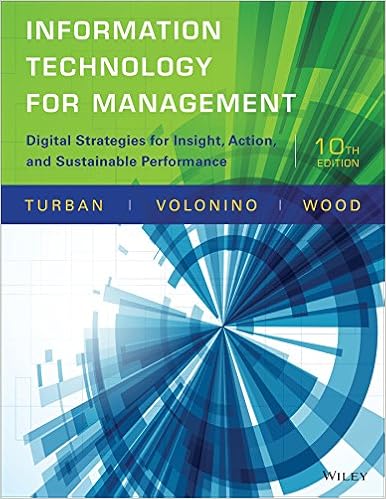
PDF Download Information Technology for Management: Digital Strategies for Insight, Action, and Sustainable Performance

PDF Download Information Technology for Management: Digital Strategies for Insight, Action, and Sustainable Performance

But right here, we will certainly reveal you amazing thing to be able always review guide Information Technology For Management: Digital Strategies For Insight, Action, And Sustainable Performance any place and whenever you occur and also time. Guide Information Technology For Management: Digital Strategies For Insight, Action, And Sustainable Performance by only can assist you to realize having the book to review each time. It won't obligate you to consistently bring the thick book anywhere you go. You can just maintain them on the device or on soft data in your computer system to always read the space at that time.

Information Technology for Management: Digital Strategies for Insight, Action, and Sustainable Performance

Information Technology for Management: Digital Strategies for Insight, Action, and Sustainable Performance


Information Technology for Management: Digital Strategies for Insight, Action, and Sustainable Performance


PDF Download Information Technology for Management: Digital Strategies for Insight, Action, and Sustainable Performance

Now, invite guide seller that will certainly come to be the best seller book today. This is it book. You may not really feel that you are not acquainted with this book, may you? Yeah, almost everybody knows about this publication. It will also go through just how the book is actually offered. When you can make the opportunity of guide with the good one, you could choose it based upon the factor and also reference of how guide will be.

However, this period likewise permit you to get guide from many sources. The off line book store may be a typical location to check out to get guide. But now, you could likewise locate it in the online library. This site is among the internet library in which you could locate your selected one to review. Now, today Information Technology For Management: Digital Strategies For Insight, Action, And Sustainable Performance is a book that you can find below. This book tends to be guide that will certainly provide you new ideas.

This book is a very well-known book that is written by famous writer. We offer this book since undoubtedly you will need it. When you discover this publication below, it is because we gather all outstanding books from lots of sources as well as libraries on the planet. It is likewise really simple to obtain this book via this site. Here, you will certainly find such link that could attach you to the library of the nation based upon guide looked. But here, we additionally precisely get the web link that shows you the soft documents of the book directly.

After reading this book, you will actually recognize how specifically the value of reading publications as common. Believe once again as exactly what this Information Technology For Management: Digital Strategies For Insight, Action, And Sustainable Performance offers you brand-new lesson, the other publications with numerous themes and also categories and also million titles will certainly also provide you exact same, or greater than it. This is why, we always offer exactly what you require and also just what you need to do. Many collections of the books from not just this nation, from abroad a nations in the world are offered here. By supplying very easy way to assist you finding the books, ideally, reading behavior will spread out quickly to other people, too.

Information Technology for Management: Digital Strategies for Insight, Action, and Sustainable Performance

About the Author

Dr. Efraim Turban obtained his MBA and Ph.D. degrees from the University of California, Berkeley. His industry experience includes eight years as an industrial engineer, three of which were spent at General Electric Transformers Plant in Oakland, California. He also has extensive consulting experience to small and large corporations as well as to governments. In his over thirty years of teaching, professor Turban has served as Chaired Professor at Nanyang Technological University in Singapore, and University of Science and Technology, in Hong Kong. He has also taught at UCLA; USC; Simon Fraser University; Lehigh University; California State University; Long Beach; and Florida International University. Dr. Turban was a co-recipient of the 1984/85 National Management Science Award (Artificial Intelligence in Management). In 1997 he received the Distinguished Faculty Scholarly and Creative Achievement Award at California State University, Long Beach. Professor Turban is currently on the faculty of City University of Hong Kong, Department of Information Systems, Faculty of Business Administration. Professor Turban's current major interest is electronic commerce, strategy, and implementation.

Read more

Product details

Hardcover: 504 pages

Publisher: Wiley; 10 edition (December 22, 2014)

Language: English

ISBN-10: 1118897781

ISBN-13: 978-1118897782

Product Dimensions:

8.7 x 0.8 x 11 inches

Shipping Weight: 2.7 pounds (View shipping rates and policies)

Average Customer Review:

3.7 out of 5 stars

37 customer reviews

Amazon Best Sellers Rank:

#104,577 in Books (See Top 100 in Books)

So far I think this is a pretty good textbook. The authors seem to know what they're talking about and the examples are timely and relevant. They've managed to get interesting insight from fortune 500 companies which is great.However, I've found the typesetting to be poor. Figures and tables are often not on the page on which they're referenced and section breaks are often mixed with content pertaining to the previous section. I think in an expensive text book, a figure should be on the page on which it's referred, that's how it was with any undergrad text book I bought for the physical sciences, there's nothing that makes IT architecture and management special or different from that... It's irritating to flip back and forth.Also the questions at the ends of each section are somewhat definition based, so they don't really make you think much about the content beyond rewriting a few sentences you just read.All in all, in spite of the good content, the book could use improvement which is why I think it's mediocre.

There are a really disappointing number of grammatical errors in this book. For someone like me who is distracted by this, it makes the book worthless because I'm so concerned with the incorrect sentences I cannot focus on the content. If an editor cannot be bothered to read this text, why should I?

The book was well received. The seller received payment quickly. Noticed the link within the amazon email was broken and did not redirect user to review or leave feedback. Noticed heavy highlighting and writing within the book upon arrival. Great book and very helpful for graduate school. Would recommend book to anyone interested in information systems.

Phenomenal book that got me through a class and also gave me insight into the industry. I learned a lot of things from the book that will be beneficial to my professional pursuits.

I don't know what to say other than I hate it- and I'm a techie! The subject matter (one I'm totally interested in by the way) was very hard to follow. Dull and lifeless. I couldn't believe that chapter after chapter this book failed to capture my attention, and I found myself becoming distracted...again and again. I put it down for a while and started reading another book by another author concerning the same subject and was almost immediately IMMERSED. I'd read through 6 chapters before I realized what I'd done. I'm guessing it's the writing styles that differ so much.

It's a textbook

Delivered on time and great product!

I learned a lot from this book that I had no idea existed. Highly recommend to those that are interested.

Information Technology for Management: Digital Strategies for Insight, Action, and Sustainable Performance PDF
Information Technology for Management: Digital Strategies for Insight, Action, and Sustainable Performance EPub
Information Technology for Management: Digital Strategies for Insight, Action, and Sustainable Performance Doc
Information Technology for Management: Digital Strategies for Insight, Action, and Sustainable Performance iBooks
Information Technology for Management: Digital Strategies for Insight, Action, and Sustainable Performance rtf
Information Technology for Management: Digital Strategies for Insight, Action, and Sustainable Performance Mobipocket
Information Technology for Management: Digital Strategies for Insight, Action, and Sustainable Performance Kindle

Information Technology for Management: Digital Strategies for Insight, Action, and Sustainable Performance PDF

Information Technology for Management: Digital Strategies for Insight, Action, and Sustainable Performance PDF

Information Technology for Management: Digital Strategies for Insight, Action, and Sustainable Performance PDF

Senin, 02 April 2018

PDF Download The Gulag Archipelago, by Aleksandr Solzhenitsyn

PDF Download The Gulag Archipelago, by Aleksandr Solzhenitsyn

The Gulag Archipelago, By Aleksandr Solzhenitsyn. In what situation do you like checking out so much? What regarding the type of the publication The Gulag Archipelago, By Aleksandr Solzhenitsyn The should check out? Well, everybody has their very own reason ought to review some books The Gulag Archipelago, By Aleksandr Solzhenitsyn Mostly, it will connect to their need to get knowledge from guide The Gulag Archipelago, By Aleksandr Solzhenitsyn and also wish to check out merely to obtain amusement. Novels, tale e-book, and also other amusing books come to be so popular this day. Besides, the clinical e-books will certainly additionally be the ideal factor to pick, specifically for the pupils, educators, medical professionals, businessman, as well as various other professions which are fond of reading.

The Gulag Archipelago, by Aleksandr Solzhenitsyn

The Gulag Archipelago, by Aleksandr Solzhenitsyn


The Gulag Archipelago, by Aleksandr Solzhenitsyn


PDF Download The Gulag Archipelago, by Aleksandr Solzhenitsyn

We think that you will certainly be interested to read The Gulag Archipelago, By Aleksandr Solzhenitsyn now. This is a new coming publication from a really renowned writer in this globe. No difficult policy, no complicated words, and no difficult sources. This book will be proper sufficient for you. This analysis product tends to be a day-to-day analysis design. So, you can review it based on your demands. Reviewing to the end finished can offer you the large outcome. As what other individuals do, many who reviewed a publication by finish could gain the benefit entirely.

If you really intend to be smarter, reading can be among the lots means to stimulate and also understand. Many individuals who such as reading will have a lot more knowledge and also experiences. Checking out can be a means to obtain info from economics, national politics, scientific research, fiction, literary works, faith, and also numerous others. As one of the part of book groups, The Gulag Archipelago, By Aleksandr Solzhenitsyn constantly ends up being one of the most wanted book. Many individuals are absolutely looking for this book. It suggests that several like to read this sort of book.

The factors may not huge concepts for reading a publication to read when being in extra time. It will also not should be so wise in undergoing the life. When you should go to the other areas and have no ideas to get the book, you can locate great deals of soft data of guide in the site that we reveal right here. As for getting the The Gulag Archipelago, By Aleksandr Solzhenitsyn, you could not have to go to guide shop. This is the moment for you to conserve the book soft file in your device and then bring it almost everywhere you will certainly go.

Maintaining the behavior for analysis is sometimes tough. There will certainly be lots of obstacles to feel bored quickly when reading. Lots of pals might pick talking or going somewhere with the others. Reviewing The Gulag Archipelago, By Aleksandr Solzhenitsyn will make other individuals feel that you are an extremely book fan. Nevertheless, the one that reads this book will not always indicate as book fan.

read. Why? Once more, this is so ideal with the subject that you truly need currently. It will also make your selection of the day to fill the time by reading this book. Even it is a type of soft file forms, The Gulag Archipelago, By Aleksandr Solzhenitsyn web content will not be different with the print from guide.

The Gulag Archipelago, by Aleksandr Solzhenitsyn

The Gulag Archipelago is Solzhenitsyn's masterwork, a vast canvas of camps, prisons, transit centres and secret police, of informers and spies and interrogators and also of heroism, a Stalinist anti-world at the heart of the Soviet Union where the key to survival lay not in hope but in despair. The work is based on the testimony of some two hundred survivors, and on the recollection of Solzhenitsyn's own eleven years in labour camps and exile. It is both a thoroughly researched document and a feat of literary and imaginative power. This edition has been abridged into one volume at the author's wish and with his full co-operation.

Read more

Product details

Paperback: 496 pages

Publisher: Vintage Uk (December 31, 2002)

Language: English

ISBN-10: 1843430851

ISBN-13: 978-1843430858

Product Dimensions:

5.3 x 1.4 x 8.5 inches

Shipping Weight: 1.2 pounds (View shipping rates and policies)

Average Customer Review:

4.4 out of 5 stars

72 customer reviews

Amazon Best Sellers Rank:

#17,839 in Books (See Top 100 in Books)

Why is this book so hard to get? Won a Pulitzer but not readily available via prime or on kindle? For one of the most important works in human history- about government oppression- I find it odd that this was so hard to get a hold of.

I regard this book as of the most needed reads of the current generation of Western Civilization. As a millennial, throughout my life there are few things that I have heard more than "the power of the collective through community." I have heard this most often in reference to some form of Communism or Socialism. Always accompanying these isms have been general statements of their respective failures as political theories quickly silenced by blanket statements such as, "Yeah, but it's a nice idea though" or "Oh yes. The USSR was an ugly blot on history of Marxism BUT that is not REAL communism. The Russians did it wrong." Those statements, not only logically fallacious but also exceedingly arrogant, comes out of the mouths of almost every young person (14 to 30) that I speak to about Communism. They believe, through the meddling of media and academia, that Communism is a caring ideology that wants what is best for others. They are all about feelings and the supremacy of people's experiences. Well, that is what Solzhenitsyn does: he brings to you the reality of the sinister totalitarianism that is Marxism. Though he is regarded as one of the finest scholars of the 20th century he has done what the millennial generation wants: he has made it personal. This book has opened my eyes to the horrors of Soviet Russia and what is more, throughout his story, he reveals important aspects of our human nature. You Western son or daughter MUST READ THIS BOOK. It will change your life if you do.

This book put in words what many of my extended family members in the Soviet Union went through. And, to think that many here in North America want to replicate that evil system here.

Although there is nothing inherently wrong with abridgements, books like this, and this book in particular, should never be abridged. I have read the 3 volume paperback version and it is worth the time...and some effort.I'm writing this review so people will know they are buying the abridged version and not as an attempt to trash this masterwork. This is a great book! Because of this it should be read in its entirety.Also, as an eBook there is no reason all 3 books could not be sold as one...after all, there is no weight to them.Happy Reading.

This book is a real page turner - I couldn't put it down. I think it's really important that people start educating themselves about the former soviet union and the real atrocities that occurred. There's been a lack of education in the US. I went to public schools and they basically told us a little bit about WWII and Nazi germany and left the soviet union entirely out of the conversation. The book smelled a little funny when it arrived but was brand new so I'm guessing just musty from storage.

Unbelievable stories from one of the most murderous times in history. We know a lot about the atrocities of the second world war but very little of this history is known to young people around the world.Aleksandr Solzhenitsyn is a master with words. The book takes time to read because you're constantly thinking about what you've just read. The content will leave you dumbfounded! This should be a set book in schools. If this information were well known to our younger generations, perhaps the world would be a different place and our future more secure.There is so much that can be learned from reading this book. I highly recommend this book to anyone who believes that we can learn from history.

Bestseller. If somebody believe that book is a picture of history which is over surely is wrong. Communism is still alive because is good for bad guys and they are multiply like worms. People cannot create system good for everybody. It is a good lesson for dreamers.

This book helped me understand the underlying causes for human misery. We all play a part in the destructive patterns in this world. Our job is to do our best to make the world better at all times. In order for evil to succeed it needs partners at all levels (leaders and followers). If we stop following and supporting we can then make it much harder for evil people to lead.

The Gulag Archipelago, by Aleksandr Solzhenitsyn PDF
The Gulag Archipelago, by Aleksandr Solzhenitsyn EPub
The Gulag Archipelago, by Aleksandr Solzhenitsyn Doc
The Gulag Archipelago, by Aleksandr Solzhenitsyn iBooks
The Gulag Archipelago, by Aleksandr Solzhenitsyn rtf
The Gulag Archipelago, by Aleksandr Solzhenitsyn Mobipocket
The Gulag Archipelago, by Aleksandr Solzhenitsyn Kindle

The Gulag Archipelago, by Aleksandr Solzhenitsyn PDF

The Gulag Archipelago, by Aleksandr Solzhenitsyn PDF

The Gulag Archipelago, by Aleksandr Solzhenitsyn PDF

Jumat, 30 Maret 2018

PDF Ebook , by David Voda

PDF Ebook , by David Voda

The , By David Voda will certainly additionally plant you great way to reach your ideal. When it happens for you, you can read it in your spare time. Why do not you try it? In fact, you will unknown how exactly this publication will be, unless you review. Although you do not have much time to complete this book quickly, it actually does not have to finish hurriedly. Select your valuable spare time to make use of to read this book.

, by David Voda

, by David Voda


, by David Voda


PDF Ebook , by David Voda

Whatever to think, regardless of what to do! When you are good visitor, you might love all publications to read. However, many individuals also like only to review particular books. And right here, when you come to be the follower of , By David Voda, this is your time ahead over the visibility of the book to stand for the excellences. Right here, guide is situated with the style of our web site. When it is the on-line sit, it will certainly aid you to discover the soft documents from the books.

As recognized, lots of people claim that publications are the vinyl windows for the world. It does not imply that getting e-book , By David Voda will certainly suggest that you can purchase this world. Simply for joke! Checking out an e-book , By David Voda will certainly opened up somebody to believe far better, to keep smile, to delight themselves, and also to motivate the understanding. Every publication likewise has their unique to influence the visitor. Have you understood why you read this , By David Voda for?

Now, you might know well that this publication is mainly suggested not just for the visitors who love this topic. This is likewise advertised for all people as well as public form culture. It will certainly not limit you to check out or not guide. However, when you have started or begun to review DDD, you will certainly know why exactly guide will provide you al positive things.

Discovering this , By David Voda as the right publication really makes you feel happy. Even this is just a book; you can discover some goodness that can not be obtained from other resources. Satisfying the interested it is at some time extremely easy, yet at some time it needs the big effort. As below, prior to locating this internet site to get the book, you might really feel so overwhelmed. Why? It's due to the fact that you really require this incredible book to read as soon as possible.

, by David Voda

Product details

File Size: 345 KB

Print Length: 17 pages

Simultaneous Device Usage: Unlimited

Publisher: eVoda (October 13, 2011)

Publication Date: October 13, 2011

Sold by: Amazon Digital Services LLC

Language: English

ASIN: B005VRWA1Y

Text-to-Speech:

Enabled

P.when("jQuery", "a-popover", "ready").execute(function ($, popover) {

var $ttsPopover = $('#ttsPop');

popover.create($ttsPopover, {

"closeButton": "false",

"position": "triggerBottom",

"width": "256",

"popoverLabel": "Text-to-Speech Popover",

"closeButtonLabel": "Text-to-Speech Close Popover",

"content": '

' + "Text-to-Speech is available for the Kindle Fire HDX, Kindle Fire HD, Kindle Fire, Kindle Touch, Kindle Keyboard, Kindle (2nd generation), Kindle DX, Amazon Echo, Amazon Tap, and Echo Dot." + '
'

});

});

X-Ray:

Not Enabled

P.when("jQuery", "a-popover", "ready").execute(function ($, popover) {

var $xrayPopover = $('#xrayPop_38CECA0E568E11E9A09BDBDAE966E34E');

popover.create($xrayPopover, {

"closeButton": "false",

"position": "triggerBottom",

"width": "256",

"popoverLabel": "X-Ray Popover ",

"closeButtonLabel": "X-Ray Close Popover",

"content": '

' + "X-Ray is not available for this item" + '
',

});

});

Word Wise: Enabled

Lending: Not Enabled

Screen Reader:

Supported

P.when("jQuery", "a-popover", "ready").execute(function ($, popover) {

var $screenReaderPopover = $('#screenReaderPopover');

popover.create($screenReaderPopover, {

"position": "triggerBottom",

"width": "500",

"content": '

' + "The text of this e-book can be read by popular screen readers. Descriptive text for images (known as “ALT text”) can be read using the Kindle for PC app and on Fire OS devices if the publisher has included it. If this e-book contains other types of non-text content (for example, some charts and math equations), that content will not currently be read by screen readers. Learn more" + '
',

"popoverLabel": "The text of this e-book can be read by popular screen readers. Descriptive text for images (known as “ALT text”) can be read using the Kindle for PC app if the publisher has included it. If this e-book contains other types of non-text content (for example, some charts and math equations), that content will not currently be read by screen readers.",

"closeButtonLabel": "Screen Reader Close Popover"

});

});

Enhanced Typesetting:

Enabled

P.when("jQuery", "a-popover", "ready").execute(function ($, popover) {

var $typesettingPopover = $('#typesettingPopover');

popover.create($typesettingPopover, {

"position": "triggerBottom",

"width": "256",

"content": '

' + "Enhanced typesetting improvements offer faster reading with less eye strain and beautiful page layouts, even at larger font sizes. Learn More" + '
',

"popoverLabel": "Enhanced Typesetting Popover",

"closeButtonLabel": "Enhanced Typesetting Close Popover"

});

});

Amazon Best Sellers Rank:

#1,090,852 Paid in Kindle Store (See Top 100 Paid in Kindle Store)

There is no worse feeling than not being able to finish a run with friends due to your thighs feeling like they are on fire and by fallowing the fitness routines in this book you can avoid that and more importantly avoid injuries. The eBook also covers proper stretching and how to deal with altitude sickness. Lucky is a seasoned snowboard instructor and really knows his stuff, I highly recommend this eBook to anyone hitting the slopes weather your a first time newbie or a seasoned expert.

Not really any super surprising or revolutionary workout info...only a few pages long. But it wasn't like it was very expensive, so this is more of a case of you get what you pay for.

A very practical guide to getting into shape. The author tailors it towards snowboarding but it honestly seems like a good general program as well. The book covers specific exercises and timetables. I was especially impressed with the section on stretching and plyometrics and the chapter on altitude sickness was also very helpful.

Solid advice, but I feel no more better off for purchasing this booklet at opposed to reading a webpage with similar information.

Before you go out snowboarding (or skiing/snowshoeing/cross-country skiiing), get this e-book to help you prepare your body to avoid injuries, make the best of high-altitudes, and get the most out of your adventure. "Lucky" has provided sound advice that will prevent the most common mistakes, injuries and pains that may occur during any strenuous winter sport. While your friends are struggling to keep up, you'll be able to have an enjoyable experience while keeping your body fit for winter sports. As a snowboard instructor, this author helps all age groups and experience levels get the most out of the sport.

I'm always a little skeptical of something that costs a buck. I figure you get what you pay for. But when I cam across this book, I thought I'd give it a shot. As a personal trainer, I'm always looking for new and innovative ways to get my clients into shape. Mr. Voda's book provides some really great creative exercises designed specifically for snowboarders. This is an author who write from what he knows of. He's not someone sitting at home watching other people snowboard. His book is highly experiential. I definitely recommend.

What a quick read to help you get in shape for the snowboarding season! Everything is laid out so clearly and simply...perfect for the novice or seasoned (pun intended) snowboarder. I had the good fortune of skiing with Lucky, and I know from personal experience that he knows his stuff!

, by David Voda PDF
, by David Voda EPub
, by David Voda Doc
, by David Voda iBooks
, by David Voda rtf
, by David Voda Mobipocket
, by David Voda Kindle

, by David Voda PDF

, by David Voda PDF

, by David Voda PDF
, by David Voda PDF

Rabu, 21 Maret 2018

PDF Download The Golden Age of Tango: An Illustrated Compendium of Its History

PDF Download The Golden Age of Tango: An Illustrated Compendium of Its History

Just how is to make sure that this The Golden Age Of Tango: An Illustrated Compendium Of Its History will not displayed in your shelfs? This is a soft documents publication The Golden Age Of Tango: An Illustrated Compendium Of Its History, so you could download and install The Golden Age Of Tango: An Illustrated Compendium Of Its History by acquiring to obtain the soft documents. It will reduce you to read it each time you need. When you really feel careless to move the printed publication from home to workplace to some place, this soft data will reduce you not to do that. Because you can only conserve the information in your computer unit and gadget. So, it enables you review it all over you have willingness to review The Golden Age Of Tango: An Illustrated Compendium Of Its History

The Golden Age of Tango: An Illustrated Compendium of Its History

The Golden Age of Tango: An Illustrated Compendium of Its History


The Golden Age of Tango: An Illustrated Compendium of Its History


PDF Download The Golden Age of Tango: An Illustrated Compendium of Its History

Discover more experiences and also expertise by reviewing the book entitled The Golden Age Of Tango: An Illustrated Compendium Of Its History This is a publication that you are trying to find, right? That's right. You have involved the best site, then. We consistently give you The Golden Age Of Tango: An Illustrated Compendium Of Its History as well as one of the most favourite publications on the planet to download and install as well as delighted in reading. You may not disregard that visiting this collection is a function or perhaps by unexpected.

Any books that you read, despite just how you got the sentences that have actually read from guides, definitely they will certainly give you goodness. But, we will certainly show you among suggestion of guide that you need to check out. This The Golden Age Of Tango: An Illustrated Compendium Of Its History is what we surely mean. We will certainly reveal you the practical reasons you have to read this publication. This book is a type of precious publication created by a knowledgeable author.

Associated with this situation, you can actually have the moment to take The Golden Age Of Tango: An Illustrated Compendium Of Its History as so as possible. Be among the great individuals who take this publication likewise for resource. For guaranteeing you to get this publication, we will certainly show how you can find and obtain the soft file of it here. Simply comply with the link that we provide and you could straight locate as well as make deal to get this book. This is just picked to get as well as wait in some device that you bring almost everywhere or in your home or workplace.

Now, when you have an additional idea to select guide, just what you can do? It will be far better as well as less complicated to locate The Golden Age Of Tango: An Illustrated Compendium Of Its History in this website since we provide you the direct link to most likely to the book site. It will certainly be much easier as well as faster to obtain it. Right here, soft data will really help you to save and also read it each time you desire. Naturally, it will certainly not limit you to read it in particular area.

The Golden Age of Tango: An Illustrated Compendium of Its History

Language Notes

Text: English (translation) Original Language: Spanish

Read more

Product details

Hardcover: 215 pages

Publisher: Art Books Intl Ltd (1996)

Language: English

ISBN-10: 9509517704

ISBN-13: 978-9509517707

Product Dimensions:

9.8 x 0.8 x 12.2 inches

Shipping Weight: 1.6 pounds

Average Customer Review:

5.0 out of 5 stars

2 customer reviews

Amazon Best Sellers Rank:

#2,382,407 in Books (See Top 100 in Books)

In almost perfect condition! I love it. For any Argentine Tango enthusiast, this book is a must have. It gives you an understanding of the history, its cultural background, the music, lyrics, the major protagonists of Argentine Tango of the past century. Beautifully written by Horacio Ferrer, the late president of the National Tango Academy of Argentina at the behest of the late Argentine president Carlos Menem. For those less lucky than me, Ferrer's previous book El Tango su Historia y Evolucion is worth going through, easier to find and less expensive.

The is the English version of Ferrer's "El Siglo de Oro de Tango". He categorized the hundred years of tango history into 8 periods, from the genesis of tango, through the development of various "orquestas tipicas", to the modernization of the music and the current popularity of its music and dance. Each period and its prominent musicians and poets were nicely described and at the end of each period, Ferrer listed the major compositions of that time. Some of these lists seem somewhat tedious for leisure reading, but they are very useful if you want to look up some particular information.The book is also beautifully illustrated with vintage photographs of the major orchestras and dancers as well as the wonderfully decorated covers of the sheet music. If you are interested in the history of tango music, this is a very good introduction and reference. This is particularly true for people who can't read Spanish fluently. Yes, it took me almost 3 months to receive my copy. But it is well worth it!Finally, just a brief biographic note on Horacio Ferrer. He was the lyricist for Astor Piazzolla for a very long time. His most famous lyrics included "balada para un loco", "Chiquilin de bachin", and "Maria de Buenos Aires" (an operita). He is currently one of the foremost tango scholars (among others such as Jose Gobello, Maria Susana Azzi, and Simon Collier).

The Golden Age of Tango: An Illustrated Compendium of Its History PDF
The Golden Age of Tango: An Illustrated Compendium of Its History EPub
The Golden Age of Tango: An Illustrated Compendium of Its History Doc
The Golden Age of Tango: An Illustrated Compendium of Its History iBooks
The Golden Age of Tango: An Illustrated Compendium of Its History rtf
The Golden Age of Tango: An Illustrated Compendium of Its History Mobipocket
The Golden Age of Tango: An Illustrated Compendium of Its History Kindle

The Golden Age of Tango: An Illustrated Compendium of Its History PDF

The Golden Age of Tango: An Illustrated Compendium of Its History PDF

The Golden Age of Tango: An Illustrated Compendium of Its History PDF

Selasa, 20 Maret 2018

Free PDF Strangers in Their Own Land: Anger and Mourning on the American Right, by Arlie Russell Hochschild

Free PDF Strangers in Their Own Land: Anger and Mourning on the American Right, by Arlie Russell Hochschild

If you have chosen to get this publication as the reading resource, currently you could invest you few time to visit the page as well as get the books. After analysis, you will definitely recognize why the reasons we share it as one of the advised outstanding books in this world. Currently, allow's do even more as well as make true of Strangers In Their Own Land: Anger And Mourning On The American Right, By Arlie Russell Hochschild to acquire.

Strangers in Their Own Land: Anger and Mourning on the American Right, by Arlie Russell Hochschild

Strangers in Their Own Land: Anger and Mourning on the American Right, by Arlie Russell Hochschild


Strangers in Their Own Land: Anger and Mourning on the American Right, by Arlie Russell Hochschild


Free PDF Strangers in Their Own Land: Anger and Mourning on the American Right, by Arlie Russell Hochschild

Million benefits of publication can be taken all if you don't just own it as your own. It will happen when you read the book, web page by web page, to complete. Besides, review it effectively can aid you to alleviate obtaining the lesson. The lesson and also benefits of guides as we states might be plenty of. You are possibly not aware that just what you really feel and also do currently end up being some parts of reading benefits of such book formerly.

As understood, we are the very best book site that constantly list several things of books from various nations. Naturally, you could find and also enjoy browsing the title by search from the nation and also various other nations in the world. It suggests that you could consider several points while find the interesting publication to review. Connected to the Strangers In Their Own Land: Anger And Mourning On The American Right, By Arlie Russell Hochschild that we conquer now, we are not question any more. Many individuals have proved it; show that this book offers excellent influences for you.

By downloading this book soft documents, you can begin reading Strangers In Their Own Land: Anger And Mourning On The American Right, By Arlie Russell Hochschild from now. It will not require you to constantly review it whenever. Juts utilize your leisure also few minutes. This is why when you wish to see how the book content is provided; you should review it from the front page. Yeah, invest your time to read it. This is our most recommended book to review when you wish to opt for some trips and also getaways.

When you have actually read it more web pages, you will know an increasing number of once more. Additionally when you have actually reviewed all completed. That's your time to constantly remember and also do just what the lesson and also experience of this publication offered to you. By this condition, you need to understand that every book ahs different means to offer the impact to any kind of visitors. Yet they will certainly be and must be. This is exactly what the DDD constantly gives you lesson concerning it.

Strangers in Their Own Land: Anger and Mourning on the American Right, by Arlie Russell Hochschild

Review

Praise for Strangers in Their Own Land: 2016 NATIONAL BOOK AWARD FINALIST FOR NONFICTION A 2016 NEW YORK TIMES NOTABLE BOOK NEW YORK TIMES BESTSELLER A NEWSDAY TOP 10 BOOK OF THE YEAR A KIRKUS BEST BOOK OF 2016 One of “6 Books to Understand Trump’s Win” according to the New York Times the day after the election "[A] smart, respectful and compelling book." —Jason DeParle, The New York Times Book Review "[Hochschild’s] analysis is overdue at a time when questions of policy and legislation and even fact have all but vanished from the public discourse." —Nathaniel Rich, The New York Review of Books "Hochschild moves beyond the truism that less affluent voters who support small government and tax cuts are voting against their own economic interest." —O Magazine "By far the best book by an outsider to the Tea Party I have ever encountered . . . a wonderful contribution to the national discourse. —Forbes "An entry pass to an alternative worldview, and with it a route map towards empathy." —The Economist "Remarkable. . . . Hochschild gives a rich and vivid picture of the emotional and social life . . . in the American South." —Sean McCann, The Los Angeles Review of Books "Hochschild comes to know people—and her own nation—better than they know themselves" —Heather Mallick, The Toronto Star "Up close there is a depth to the concerns of Hochschild's subjects . . . They are concerned about pollution, and about the social decay that we see most vividly in the opioid epidemic. They are aware . . . of facts on the ground." —Benjamin Wallace-Wells, The New Yorker "Strangers in Their Own Land is extraordinary for its consistent empathy and the attention it pays to the emotional terrain of politics. It is billed as a book for this moment, but it will endure." —Gabriel Thompson, Newsday [Hochschild's] connection and kindness to the people she meets is what makes this book so powerful. —Marion Winik, Minneapolis Star Tribune "Hochschild is fascinated by how people make sense of their lives . . . [She] conveys that she genuinely likes the people she meets, communicating their dignity and values . . . . These attentive, detailed portraits . . . reveal a gulf between Hochschild's Strangers in Their Own Land and a new elite." —Jedediah Purdy, The New Republic "The importance of emotion in politics, not just facts and figures, [Hochschild] writes convincingly, is critical to understand...a point politicians of all stripes would be smart to remember." —Felice Belman, The Boston Globe "Hochschild has gone about her investigation diligently and with an appealing humility." —Karen Olsson, Bookforum "An important contribution to the understanding of our times... Strangers in Their Own Land describes in vivid detail a world that is often ignored or caricatured by the media and by many liberals." —The Nation "[Hochschild's] deeply humble approach is refreshing and strengthens her research . . . . She skillfully invites liberal readers into the lives of Americans whose views they may have never seriously considered. After evaluating her conclusions and meeting her informants in these pages, it's hard to disagree that empathy is the best solution to stymied political and social discourse." —Publishers Weekly "A well-told chronicle of an ambitious sociological project of significant current importance." —Kirkus Reviews "If the great political question of our time can be summarized in the two words, 'Donald Trump,' the answer is to be found in Arlie Russell Hochschild's brilliant new book, Strangers in Their Own Land: Anger and Mourning on the American Right. Hochschild, an eminent sociologist with a novelist's storytelling skill, has crafted an absorbing tale full of richly drawn, complicated characters who come bearing their own fascinating histories. Together, in Hochschild's authoritative hands, they offer a compelling and lucid portrait of what had seemed a bewildering political moment. A powerful, imaginative, necessary book, arriving not a moment too soon." —Mark Danner, author of Spiral: Trapped in the Forever War "Arlie Hochschild journeys into a far different world than her liberal academic enclave of Berkeley, into the heartland of the nation's political right, in order to understand how the conservative white working class sees America. With compassion and empathy, she discovers the narrative that gives meaning and expression to their lives–and which explains their political convictions, along with much else. Anyone who wants to understand modern America should read this captivating book." —Robert B. Reich, Chancellor's Professor of Public Policy, University of California, Berkeley "The celebrated sociologist Arlie Hochschild left Berkeley and went far outside her comfort zone to live among and report on Tea Party members in Louisiana over five years. With the clear-headed empathy she is famous for, she explored the central paradox of these political activists in the heart of 'cancer alley': they understand that the chemical and oil companies have destroyed their environment and sometimes their lives, but they remain ardent defenders of free market capitalism. Hochschild spent many hours—at church services, picnics and kitchen tables—probing the ways they struggle to reconcile their conflicting interests and loyalties. There could not be a more important topic in current American politics, nor a better person to dissect it. Every page—every story and individual—is fascinating, and the emerging analysis is revelatory." —Barbara Ehrenreich "In her attempt to climb over the 'empathy wall' and truly understand the emotional lives of her political adversaries, Arlie Hochschild gives us a vital roadmap to bridging the deep divides in our political landscape and renewing the promise of American democracy. A must-read for any political American who isn't ready to give up just yet." —Joan Blades, co-founder of LivingRoomConversations.org, MomsRising.org, and MoveOn.org "Arlie Russell Hochschild's work has never been more timely or more necessary, from the resurgence of interest in emotional labor to this deep, empathetic dive into the heart of the Right. Strangers in Their Own Land does what few dare to do—it takes seriously the role of feelings in politics." —Sarah Jaffe, author of Necessary Trouble: Americans in Revolt

Read more

About the Author

Arlie Russell Hochschild is one of the most influential sociologists of her generation. She is the author of nine books, including The Second Shift, The Time Bind, The Managed Heart, and The Outsourced Self. Three of her books have been named as New York Times Notable Books of the Year and her work appears in sixteen languages. The winner of the Ulysses Medal as well as Guggenheim and Mellon grants, she lives in Berkeley, California.

Read more

Product details

Paperback: 368 pages

Publisher: The New Press; First Trade Paper edition (February 20, 2018)

Language: English

ISBN-10: 1620973499

ISBN-13: 978-1620973493

Product Dimensions:

5.4 x 1.2 x 8.2 inches

Shipping Weight: 12.8 ounces (View shipping rates and policies)

Average Customer Review:

4.4 out of 5 stars

597 customer reviews

Amazon Best Sellers Rank:

#7,244 in Books (See Top 100 in Books)

Arlie R Hochschild is a sociology professor at UC Berkley. In this book she has compiled an interesting story of how people think on the right. She was concerned about the “increasingly hostile split in our nation between two political camps.” To do this, she spent about five years in Louisiana talking with people on the other side of her “empathy wall” as she calls it. The empathy wall is defined as an obstacle that prevents a deep understanding with another person. It can make us feel hostile or indifferent to the beliefs of others. The book is divided into four main parts: The Great Paradox, The Social Terrain, the Deep Story and the People in It, and, finally, Going Natural.She picked Louisiana because it presented an extreme example of what she called the “great paradox.” Statistics show that this state ranks very low in “human development.” - it ranks 49th. In overall health, it ranked last, it ranked 48th in eight-grade reading, 49th out of 50 in eight-grade math, and 49th in child well-being. Yet these same people will spurn most federal help. Even so, 44 percent of the state’s budget comes from the federal government. As Alec MacGillis of the NY Times stated, “People in red states who need Medicaid and food stamps welcome them but don’t vote…while those a little higher on the class ladder, white conservatives, don’t need them and do vote – against public dollars for the poor.” When it comes to the significant pollution from the petrochemical industry, the logic is “the more oil, the more jobs. The more jobs, the more prosperity, and the less need for government … the better off they will be.”In the subsequent chapters of Part II, the author enters the “social terrain” of the people to investigate how the basic institutions of industry, state government, church, and the press influenced their feelings about life. The author has many conversations with the people living there and relates the narratives for us. We get a firsthand look at just how the people think, and what influences their opinions.In Part III, the author discuss the “deep story” of the people. She defines this as the story feelings tell in the language of symbols, removing judgement and fact. It allows both sides to “explore the subjective prism through which the party on the other side sees the world.” It represents, in metaphorical form, “the hopes, fears, pride, shame, resentment, and anxiety in the lives” of those she talked to. We see how racism, discrimination, sexism, oppression, gender issues, class, and immigration play into their sympathies.In the final section, the author provides a contrast between the 1860s and the 1960s before delving into something called “collective effervescence,” referring to the “state of emotional excitation felt by those who join with others they take to be fellow members of a moral biological tribe.” In her travels, Hochschild was humbled by the complexity and height of the empathy wall, but felt that the people she met in Louisiana showed that the wall could easily come down, and that there is a possibility for practical cooperation.The book concludes with three appendixes. Appendix A describes the research, Appendix B talks about the relationship of politics and pollution, and Appendix C covers fact-checking.

Many liberals find it baffling that so many of the people most likely to be seriously hurt by the policies of the Republican Party are among its most enthusiastic supporters. Respected sociologist Arlie Russell Hochschild calls this the “Great Paradox” and sets out to solve the mystery. She travels to Louisiana bayou country, one of America’s reddest regions and a Tea Party stronghold, to get to know and understand the people. She listens to them with respect, attention, and compassion in an effort to provide insight and understanding to those on the other side of the “empathy wall.” An explanation of the “Great Paradox” does in fact emerge from these journeys - and it is not comforting.Hochschild begins with the devastating effects of chemical dumping and other forms of pollution on the environment. Incredibly, Louisiana loses a patch of wetland the size of a football field every hour. Hochschild tells story after story of environmental catastrophe. For example, there was the Bayou Corne Sinkhole.In the summer of 2012 people started noticing tiny clusters of bubbles on the water surface. This was accompanied by a strong smell of oil. Then the ground began to shake: incredibly, an earthquake had hit Louisiana. One man found a crack in the concrete beneath his living room carpet snaking its way across the room.The bayou began breaking apart. A huge gaping hole opened at the bottom and swallowed trees and shrubs and grassland. An oily sheen covered the water surface. In place of the disappearing forest the bayou regurgitated a polluted oily sludge, which expanded to threaten the drinking water supply. The sinkhole grew to over thirty-seven acres.The guilty party was a drilling company called Texas Brine. In total disregard of regulations it began drilling underneath the bayou for concentrated salt deposits used for fracking. The drilling caused underground structures to collapse, creating the sinkhole.Then there is the picturesque story of the “Rubberized Horse,” as told by a retired schoolteacher about when he was a young boy growing up in the 1950’s: “'I was riding my palomino horse, Ted,' he recalls. 'Normally Ted cleared ditches five feet across just fine. But this time the horse fell back into the water and sank down. He tried to climb up but couldn’t. We tried to pull his reins, but couldn’t get him up. Finally my uncle hauled him out with a tractor. But when Ted finally scrambled back out, he was coated all over with a strange film. I hosed him off but that only hardened the film on him. It was like a terrible glued­-on wet suit. It was like rubber. The vet tried but couldn’t save him, and Ted died two days later.' The ditch was downstream from a Firestone polymers plant” (p. 163).In many parts of bayou country other types of industrial carelessness have resulted in undrinkable water, inedible fish, and increasing cancer rates. People would try to minimize their chances of being poisoned by cutting out and throwing away the fatty parts of the fish, where toxins tended to concentrate. An entire culture of fishing suffered severe damage. Nevertheless, voters in this region have repeatedly elected politicians committed to deregulation and dismantling the EPA. To them no villain is worse than “big government,” even at the expense of their health.The antipathy towards “big government” is especially ironic, since Louisiana is one of the states that receives more from the federal government than it sends in taxes. In fact, 44% of the Louisiana state budget comes from the federal government. Yet Louisianans tend to oppose big-government “meddling” and regulating everything. This is why industrial interests like to locate in red states, putting their environments at risk. They have a much easier time getting away with abusing the environment than they would in blue states where community opposition is likely to be fierce.Nevertheless, big government is the enemy, and the reasons are revealing. Of course one big reason is taxes. Nobody likes taxes, even if your state gets back a disproportionate share of them. But there are more compelling, deeply emotional reasons for this anti-government attitude, which ultimately provide the solution to the “Great Paradox.” The federal government is perceived to be the ally of people whom this working-class white population deeply resents.To many of these people federal taxes represent both insult and injury. It’s bad enough that people have to pay them; what’s even worse is that the money goes to welfare beneficiaries who “laze around days and party at night.” Hochschild found this to be a very common sentiment: "As one man explains, 'A lot of us have done okay, but we don’t want to lose what we’ve got, see it given away.' When I ask him what he saw as being 'given away,' it was not public waters given to dumpers, or clean air given to smoke stacks. It was not health or years of life. It was not lost public sector jobs. What he felt was being given away was tax money to non­working, non­deserving people - and not just tax money, but honor too" (p. 60).As one continues hearing these sentiments, one cannot help noticing how race so often plays a role in them. “'I don’t like the government paying unwed mothers to have a lot of kids, and I don’t go for affirmative action. I met this one black guy who complained he couldn’t get a job. Come to find out he’d been to private school. I went to a local public school like everyone else I know. No one should be getting a job to fill some mandated racial quota or getting state money not to work'” (p. 92).Sometimes, as above, one might hear race explicitly mentioned. More often it was not. The acceptable phrase, which Hochschild heard over and over, was “line cutter.” The real problem with this country is the “line cutters,” people who jump their place in line for the American Dream, while those in the poor white working class have been patiently waiting their turn for years. The “big government” that oppresses them gives unfair advantages to the line cutters, in the form of welfare payments, affirmative action, and recognition of special status. People who have worked hard all their lives with little to show for it must witness the undeserving “line cutters” moving ahead of them, and we all know who those are: blacks, foreigners, and anyone who receives government handouts. This even includes Medicaid: there is a widespread but mistaken belief that people on Medicaid do not work, even though it is documented that most Medicaid recipients do work (and of course many are children, or are too old, sick, or disabled - especially the nursing home population). So if Republicans want to do away with Medicaid, don’t expect much outcry here: let everybody work for what they get instead of leeching off the public dole.As Hochschild describes it, this resentment of the line jumpers has been simmering for years: "The 1960s and 1970s set off a series of social movements, which, to some degree, shuffled the order of those “waiting in line” and laid down a simmering fire of resentment which was to flame up years later as the Tea Party. During this era a long parade of the underprivileged came forward to talk of their mistreatment - blacks who had fled a Jim Crow South, underpaid Latino field workers, Japanese internment camp victims, ill-­treated Native Americans, immigrants from all over. Then came the women’s movement. Overburdened at home, restricted to clerical or teaching jobs in the workplace, unsafe from harassment, women renewed their claim to a place in line for the American Dream. Then gays and lesbians spoke out against their oppression. Environmentalists argued the cause of forest animals without forests. The endangered brown pelican, flapping its long, oily wings, had now taken its place in line" (p. 211).It seems that every group favored by liberal Democrats has offended these people in some way - including the pelican. But there is more. This simmering resentment has acquired the power of an erupting volcano because of a seismic demographic shift: "All these social movements left one group standing in line: the older, white male, especially if such a man worked in a field that didn’t particularly help the planet. He was - or was soon becoming - a minority too" (p. 212).We could hardly have expected the country to experience such a transformation without political consequences. So after eight years of a black President it is hardly surprising to see instead a regime seemingly sympathetic to white supremacy. Some interviewees compared the present situation to the Civil War: that too was an example of an overbearing Northern government with far too much power dictating to people how they should live. "Whatever their family’s view or their own, however much sympathy they may have personally felt for blacks at the time, the public narrative was that the North had to come to the South, as it had with soldiers in the 1860s and during Reconstruction in the 1870s, to tell Southern whites to change their way of life" (p. 213). "Culturally speaking, the entire North had 'cut in' and seemed to move the South to the back of the line, even as - and this was forgotten - federal dollars had steadily moved from North to South" (p. 215).Overthrowing the liberal black President was a long overdue swipe at the carpetbaggers.This explains why arguments that Republican policies exploit the poor in favor of the rich, and that these policies increase income inequality, have no persuasive power. The people whom these policies victimize have it coming. "Liberals were asking them to feel compassion for the downtrodden in the back of the line, the “slaves” of society. They didn’t want to; they felt downtrodden themselves and wanted only to look “up” to the elite. What was wrong with aspiring high? That was the bigger virtue, they thought. Liberals were asking them to direct their indignation at the ill-­gotten gains of the overly rich, the “planters”; the right wanted to aim their indignation down at the poor slackers, some of whom were jumping the line" (p. 219).To Hochschild’s credit, these observations came to light through her efforts to listen sympathetically and try to understand people with whom she did not agree. Her success in drawing them out makes this book an important contribution to understanding the anomalies of our current political situation.Conclusion: White Resentment and the Rise of TrumpIn my own debates with Trump supporters (and I’ve gotten into more of those than I probably should have), I’ve been struck by something odd. Appeals to moral principles that I believed we shared had absolutely no effect. So my conversation partners had no response to the immorality of throwing millions of people off health insurance in order to make rich people even richer, or to tearing apart the families of undocumented immigrants who have committed no offenses and who fled to this country seeking asylum. And they didn’t care that they had no response. This baffled me, until reading this book helped me finally understand how to resolve the “Great Paradox.“So many of us who tried to fathom the outcome of this bizarre election had no clue about an important dynamic that drove the result. In light of Hochschild’s research, the outcome now seems to have been almost inevitable. "Looking back at my previous research, I see that the scene had been set for Trump’s rise, like kindling before a match is lit. Three elements had come together. Since 1980, virtually all those I talked with felt on shaky economic ground, a fact that made them brace at the very idea of 'redistribution.' They also felt culturally marginalized: their views about abortion, gay marriage, gender roles, race, guns, and the Confederate flag all were held up to ridicule in the national media as backward. And they felt part of a demographic decline; 'there are fewer and fewer white Christians like us'” (p. 221).Donald Trump read this mindset better than any other candidate. And being the great salesman that he is, he won by selling a product, a very potent one, more powerful even than this country’s sense of morality, tradition, and decency. Trump won by selling resentment.This is why behavior that under normal circumstances would have disqualified any other candidate only seemed to make Trump’s candidacy stronger. The apparent sympathy with white supremacists, the overt appeals to racism, the misogyny and the hatred of immigrants and Muslims, all resonated with a large segment of the voting public. If Trump insulted Obama with his birther lie, insulted blacks by insinuating that all black neighborhoods are hotbeds of crime, insulted women by bragging about how he could freely abuse them, or repeatedly expressed hatred of Latinos and Muslims, it did not delegitimize him. It strengthened his appeal. "In other speeches Trump said, in reference to a protestor, 'I’d like to punch him in the face' (February 23, 2016). 'In the good old days they’d have ripped him out of that seat so fast' (February 27, 2016). 'Knock the crap out of him, would you? Seriously . . . I promise you I will pay for the legal fees. I promise. I promise'” (p. 224).What other presidential candidate in modern history could have gotten away with speaking like this? And yet not only did enough voters find this acceptable, it energized and inspired them. Trump hated all the people they hate. It was about time.Trump’s cruelty did not count against him; instead it was considered a virtue. "Trump jovially imitated a disabled journalist by physically shaking his arm in imitation of palsy - all deeply derogatory actions in the eyes of Trump’s detractors but liberating to those who had felt constrained to pretend sympathy. Trump allowed them both to feel like a good moral American and to feel superior to those they considered 'other' or beneath them" (p. 228).Trump gave people permission to feel sorry for themselves instead of for others who might need help but who are not like them. So not only could he get away with his outrageous statements and behavior, it was just what his voters wanted.How naïve Michelle Obama’s words now seem: “When they go low, we go high.” How did that work out for the Democrats? The voters who gave us Donald Trump did not want to go high. Going high had no attraction for them. They wanted low and Trump gave it to them, while astonished Democrats watched and wondered why Trump’s excesses did not destroy him. In retrospect the reason is obvious.Perhaps the deepest irony of this entire phenomenon is that the resentment that blew Trump into office was tragically misplaced. It is not the fault of black people or of Mexicans that manufacturing jobs no longer exist in abundance. The world is changing, and either one adapts or gets swept away. Scapegoating, taking it out on others is always self-destructive. And so it will be again. The Republicans’ anti-environment and financially predatory policies will hurt most the poor white voters who looked to them for salvation.We are now left with the incalculable damage this election has done. Internationally, we have placated our enemies and alienated our friends. Our standing in the world has plummeted, and hatred of the “ugly American” has no doubt risen dramatically. We have gone on record as the only industrialized nation not to care about the state in which we leave this planet for future generations, but to care only about ourselves. “America First,” no matter the cost to anyone else. Domestically, we are pursuing policies that punish the most frail and vulnerable members of our society. Republicans, who have succeeded in demonizing a health care program that actually works if given a chance (and if Republicans do not sabotage it), are pushing their own “health” bill that is nothing of the kind. It is not about health care, but rather about seeing how many services for poorer Americans they can get away with cutting. Meanwhile the honor and prestige of the Presidency have been torn to shreds by a President who would rather spend his time composing adolescent tweets and watching himself on TV than actually studying policy and attending to governance. One great horror in all this is that we may actually come to accept it as the new normal.Whenever policy is driven by resentment, the result is self-destructive. The people who elected Trump bear an ethical stain. Too many of them have allowed resentment to drive their policy. Everybody knew what Trump was. He made no attempt to hide his dark side; in fact, he flaunted it. And that is what people voted for. They voted for someone who was clearly inexperienced, emotionally immature, consistently dishonest, and with a mean streak deep as a chasm. And they voted for him not in spite of that but because of it.Hochschild’s is perhaps the deepest of many efforts people have made to understand Trump voters, to sympathize with their plight, and to record their grievances. I have not seen even one comparable attempt made by the other side. The Republicans won both houses of Congress and the Presidency, and now even the Supreme Court, yet somehow only those who lost the election and who feel devastated by that loss have an obligation to understand and sympathize with the other side. That moral inequivalence speaks volumes. But as we have seen, against resentment morality may be powerless.Finally, it is undeniable that racism played a significant role in Trump’s victory. People who harbor ill feelings towards other races or ethnic groups always have reasons for feeling the way they do, and there are always things we can try to “understand.” In this case the predominant rationalization is that members of the disliked groups, and their black President himself, are “line cutters” who are reaching beyond what they deserve, and we need to understand why poor working whites may feel that way. The term “line cutters” is code. It suggests a hierarchy of privilege, that people should know their place and stay in it, and clearly has racial overtones. Is this supposed to elicit our sympathy?In the end racism is either justifiable or it is wrong. And as we keep witnessing the destructive consequences of this administration’s policies and values, it will not do to cast those who brought us here as victims of a changing world whom we should feel sorry for. People are responsible for the choices they make and for the ethical consequences of those choices, no matter how much they may believe they have suffered in comparison to others. It is not just everybody else who has a duty to “understand” those who bear strong feelings against other races and ethnicities; it is the duty of those who entertain such sentiments to examine them and correct them. Only then can we achieve a healthy society that works for all.To a large extent this election was a repudiation of eight years of a nonwhite President by a group that feels threatened because its numbers and power are shrinking. It is hard to understand in any other way the intense and unprecedented hatred thrown at Obama since the very first day of his administration. Republicans shamelessly declared that their highest priority was not to work together to improve American lives, but to thwart him at every turn and make him a one-term President. Likewise the unceasing efforts to demonize and make unworkable a health care bill whose greatest sin is to bear the name of a black Democratic President. But I believe that the growing diversity in this country is actually a great strength. Hopefully the turmoil of this election is a temporary phase this country must work through as it learns to accept this diversity. Hochschild has laid bare the underlying dynamic of the resistance aganst it. We just need the willingness to confront the meaning of these findings.

I have been fortunate to become familiar with the places and people of Louisiana described in this book and I can't begin to express how grateful I am to the author for delving into explaining "the great paradox". I am Californian born and raised and originally traveled to southwest Louisiana to pick up an accordion made by Mark Savoy in Eunice LA. I keep returning because the people I met, and friends I made, are as kind, gentle, open and intelligent as the folks described here. But, try as I might to reconcile the differences in our social/political views I failed....until I read this book! Thank-you Arlie Russell Hochschild for offering this bridge between the right and the left. Fellow MSNBC watchers, after reading this book I urge you to visit southwest Louisiana yourself - you will never view "the South" or Southerners, the same.

Strangers in Their Own Land: Anger and Mourning on the American Right, by Arlie Russell Hochschild PDF
Strangers in Their Own Land: Anger and Mourning on the American Right, by Arlie Russell Hochschild EPub
Strangers in Their Own Land: Anger and Mourning on the American Right, by Arlie Russell Hochschild Doc
Strangers in Their Own Land: Anger and Mourning on the American Right, by Arlie Russell Hochschild iBooks
Strangers in Their Own Land: Anger and Mourning on the American Right, by Arlie Russell Hochschild rtf
Strangers in Their Own Land: Anger and Mourning on the American Right, by Arlie Russell Hochschild Mobipocket
Strangers in Their Own Land: Anger and Mourning on the American Right, by Arlie Russell Hochschild Kindle

Strangers in Their Own Land: Anger and Mourning on the American Right, by Arlie Russell Hochschild PDF

Strangers in Their Own Land: Anger and Mourning on the American Right, by Arlie Russell Hochschild PDF

Strangers in Their Own Land: Anger and Mourning on the American Right, by Arlie Russell Hochschild PDF